
AGN flux
variability
One of the defining properties of Active Galactic Nuclei is that the radiation they emit, as matter falls into the central black hole, is highly variable with time, i.e. it fluctuates around a mean value (see Figure above). It has long been known that the “flickering” of the emitted light, although stochastic in nature, is not completely random: it is not possible to precisely predict how bright an AGN shines at any given time, but the probability of a particular brightness can be mathematically quantified.
Astronomers have been using this “flickering” to study the geometry and dynamics of the inner regions of AGN close to the supermassive black hole. A comprehensive picture of the statistical properties of the AGN brightness variations with time is therefore the stepping stone toward models and theories that describe how matter is distributed around black holes and eventually plunges into them.
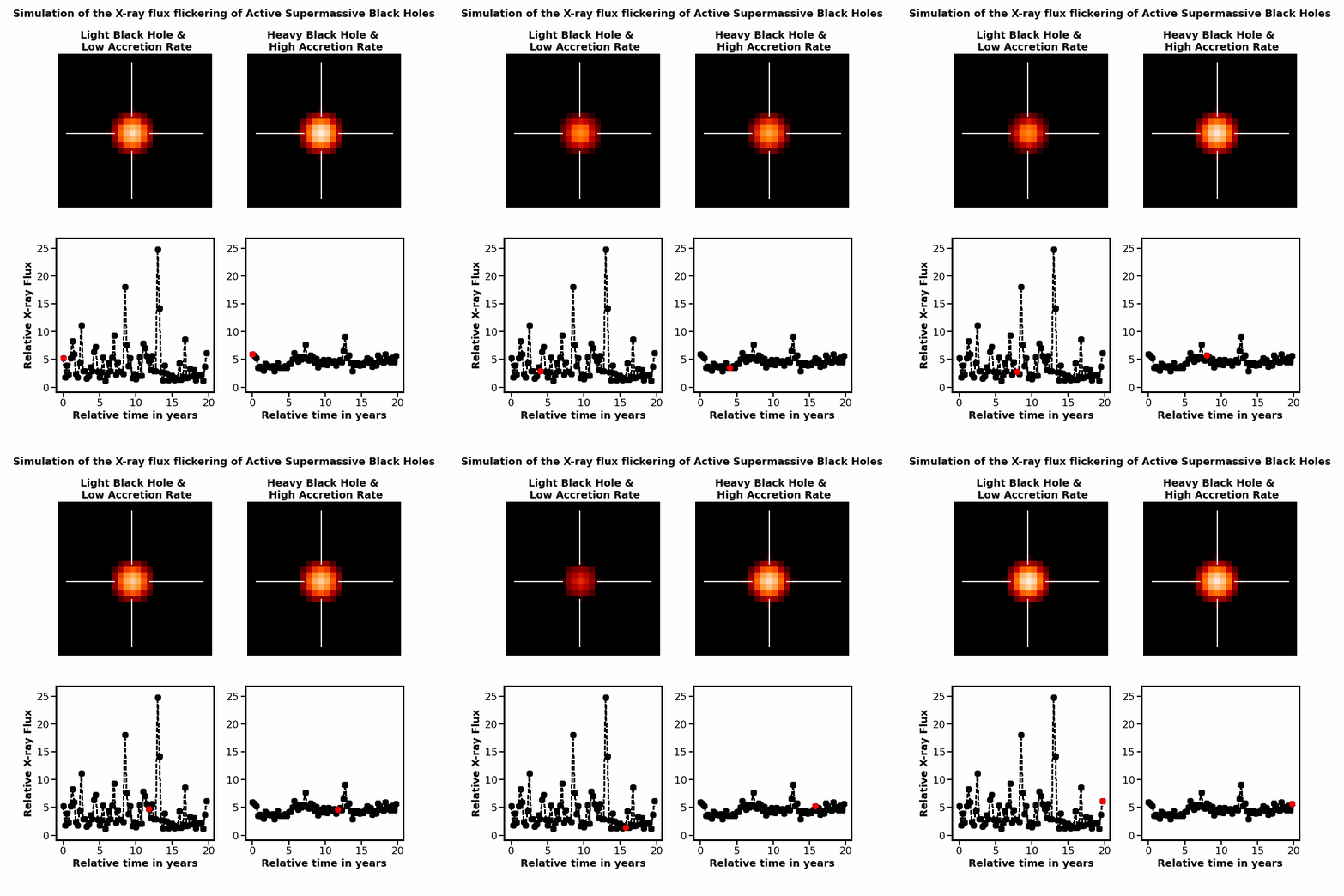
Animated view of an X-ray source flickering in time, with an inset showing its evolving light curve. As the source brightens and dims, the light-curve marker moves correspondingly, illustrating how changes in brightness translate into the observed variability pattern characteristic of transient X-ray phenomena.
The 4MOVE-U team has been looking into the variability of AGN at X-ray wavelengths to quantify how the amplitude and frequency of the observed brightness fluctuations depend on the fundamental physical properties of the accreting system, such as the mass of the black hole and the rate at which matter falls onto it. Analysing observations from state-of-the-art X-ray telescopes, such as the German eROSITA and the European XMM-Newton, the 4MOVE-U researchers showed that more massive black holes or black holes that are fed with material at a high rate appear to emit X-ray radiation with a low level of variability. Instead lighter black holes or those that accrete material at a low rate exhibit larger variations in their X-ray flux. This trend is demonstrated in Figure 2, which shows realistic simulations of the X-ray flickering of AGN with different black hole masses and accretion rates.
Simulation of the
X-ray flux flickering
of an Active Supermassive Black
The top row shows simulated X-ray images of active supermassive black holes observed at different times over a simulated period of 20 years. On the left is the example of a low-mass (light) black hole (108 solar mass) accreting at a low rate. On the right is a heavy black hole (109 solar mass) accreting at a high rate. The simulated light active supermassive black hole on the left is varying more erratically than the heavy one on the right. The bottom panels show how the simulated flux of these active supermassive black holes change with the time over the period of 20 years. The data points on the left (light black hole) show significantly higher dispersion, i.e. higher amplitude of variability, compared to the data point on the right (heavy black hole).
The 4MOVE-U researchers were able to demonstrate these trends at a high level of confidence thanks to the quality and volume of the data they used. They combined observations from two European X-ray telescopes, the XMM-Newton of the European Space Agency and the eROSITA operated by a consortium of German astronomy institutes, to study the X-ray flux variations of an unprecedented in size sample of AGN spread across the sky. Details can be found in Georgakakis et al. (2024).